Uncategorized

what is local seo
Uncategorized

How to Rank on Google Maps: The Complete Guide for UK Local Businesses

When someone types “plumber near me” or “best Italian restaurant” into their phone, the businesses that appear in the map section at the top of the results get the lion’s share of calls, visits and bookings. If you want to know how to rank on Google Maps, you are really asking how to win those prime spots, known as the Google local pack. The good news is that you do not need a huge budget or a technical background. You need a well-built Google Business Profile, consistent business information, genuine reviews and a website that backs it all up. This guide walks you through every step, in plain English, so you can rank higher on Google Maps and keep your position. If you would rather have experts handle it, the team at SEO Near Me helps UK businesses climb the local rankings every day. What Is Google Maps Ranking and Why Does It Matter? Google Maps ranking is the position your business appears in when people search for local services, either in the Maps app or in the three-business “local pack” shown on the main Google results page. It matters because local searches carry strong buying intent. People searching for a nearby service usually want it today. Being in the top three results can be the difference between a full diary and a quiet week. Google Maps SEO is simply the practice of optimising your business so Google trusts it enough to show it first. It overlaps with traditional SEO, but it has its own rules and priorities. How Google Decides Who Ranks: The Three Core Google Maps Ranking Factors Google has confirmed that local results are based mainly on three things. Relevance. How well does your profile match what the person searched for? Your categories, services and description all help Google understand what you do. Distance. How close are you to the searcher, or to the location they typed in? You cannot change where your premises are, but you can make sure your address is accurate and your service areas are set correctly. Prominence. How well known and trusted is your business? Reviews, mentions around the web, links to your website and your general online reputation all feed into prominence. Every tactic in this guide improves one or more of these three Google Maps ranking factors. Step 1: Claim and Verify Your Google Business Profile If you want to get on Google Maps, this is where it starts. Your Google Business Profile (formerly Google My Business) is the foundation of your Google business profile ranking. Until you are verified, you will not appear properly. Once verified, your business can appear on Google Maps for relevant searches. Step 2: Choose the Right Categories Your primary category is one of the strongest signals you control. Pick the one that best describes your main service, not the broadest one. A business that chooses “Italian restaurant” will usually outperform one that picks just “Restaurant” when someone searches for Italian food. Then add secondary categories for other services you genuinely offer. A dentist, for example, might add “Cosmetic dentist” or “Emergency dental service”. Do not add categories you do not truly cover, as irrelevant ones dilute your relevance. A quick way to research is to look at the top three competitors in your area and see which categories they use. Many free browser tools reveal this. Step 3: Get Your NAP Details Perfectly Consistent NAP stands for Name, Address and Phone number. Google cross-checks these details across the internet. If your business is “Smith & Sons Plumbing Ltd” on one directory and “Smiths Plumbers” on another, with two different phone numbers, you create doubt. To fix this: For UK businesses, make sure you appear in the major directories such as Yell, Thomson Local, Bing Places, Apple Business Connect, Checkatrade or Trustpilot where relevant, plus industry-specific sites. These listings are called citations, and consistent ones strengthen your prominence. If you want to rank on Google Maps UK-wide or in a specific city, local citations from regional sites help too. Step 4: Write a Strong Business Description and Complete Every Field Profiles that are 100% complete tend to perform better. Fill in everything Google offers: This is the heart of Google Maps optimisation: giving Google as much accurate detail as possible so it can match you with the right searches. Step 5: Upload High-Quality, Real Photos Photos build trust and drive clicks. Businesses with plenty of photos typically get more direction requests and website visits than those with few. Upload: Use real photos, not stock images. Add new ones regularly, ideally weekly or monthly. It signals that your business is active. Step 6: Collect and Respond to Reviews Reviews are one of the biggest drivers of both rankings and conversions. Google looks at the quantity, quality, recency and content of your reviews. How to get more reviews ethically: Never buy reviews, offer discounts in exchange for them or review-gate by only asking satisfied customers. These practices break Google’s rules and can get reviews removed or your profile penalised. Respond to every review. Thank people for positive feedback and answer negative ones calmly and professionally. Replies show Google and future customers that you are engaged. If customers naturally mention your services or location in their reviews, that adds relevance too. Step 7: Use Posts, Q&A and Messaging Google Posts let you share offers, events and updates directly on your profile. They are not a massive ranking factor on their own, but they encourage clicks and show the profile is active. Aim to post at least once a week. The Questions & Answers section is also worth attention. Seed it yourself by asking and answering common questions, such as “Do you offer weekend appointments?” Monitor it so incorrect answers from strangers do not stay up. If you turn on messaging, reply promptly. Fast responses improve customer experience and conversions. Step 8: Optimise Your Website for Local Search Your website supports your profile. A strong, locally focused site

what is local seo
Uncategorized

What Is Local SEO? A Beginner’s Guide for UK Businesses

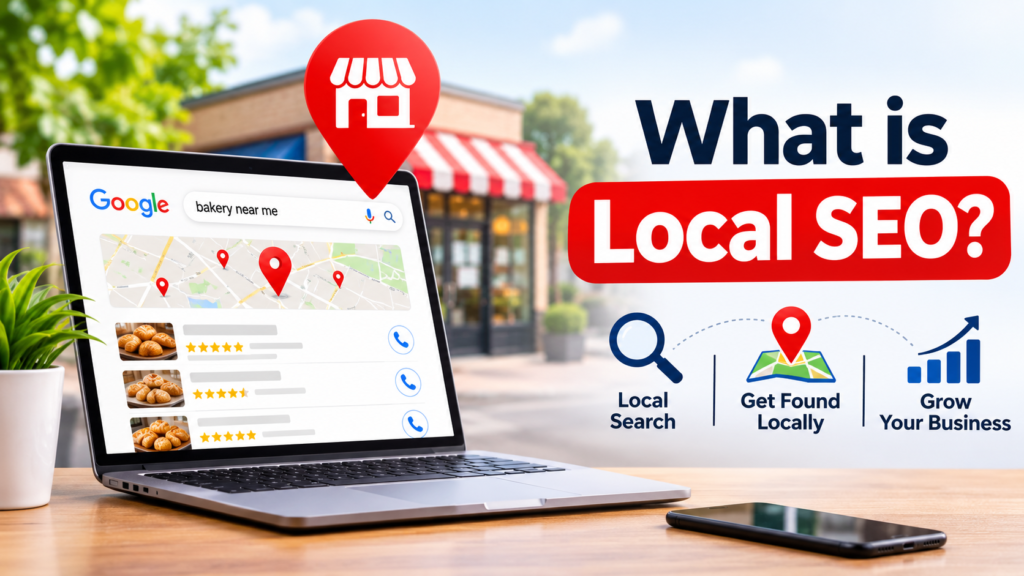
Think about the last time you searched for “dentist near me” or “plumber in Leeds”. You probably didn’t scroll past page one. You looked at the map, checked a few reviews, and called the business that looked most trustworthy. That moment is exactly what local SEO is about. If you run a business that serves customers in a particular area, understanding it could be one of the most valuable things you do for your marketing. So, what is local SEO? This guide explains it in plain English, covers how it works, what Google looks at, and what you can do today to start showing up when local customers search. Local SEO Meaning: The Simple Definition Local SEO (local search engine optimisation) is the process of improving your business’s visibility in search results for people searching in a specific location. It helps your business appear when someone looks for products or services nearby, whether they type the town name or simply add “near me”. It’s often called local search optimisation, and it focuses on three main places where local customers find you: If your business has a physical premises, or travels to customers within a defined area, local SEO is built for you. Local SEO Examples Examples make this much easier to picture. In each case, the customer is ready to act. That’s why local searches are so valuable: they’re often the final step before a phone call, visit or booking. Why Local SEO Matters Why local SEO matters comes down to one thing: intent. People searching locally are usually close to buying. They aren’t browsing for ideas; they’re looking for someone to help them now. Here’s why it deserves your attention: If you’re a small business owner, this is probably the highest-return form of marketing you can invest in. Local SEO vs SEO: What’s the Difference? Many people assume local SEO and regular SEO are the same thing. They share foundations, but they have different goals. Traditional SEO Local SEO Goal Rank for searches nationally or globally Rank for searches in a specific area Key platform Google organic results Google Business Profile, Maps and local results Main signals Content, backlinks, technical health Proximity, relevance, prominence, reviews Best for Online shops, publishers, national brands Shops, trades, clinics, restaurants, service providers Example search “best running shoes” “running shoe shop near me” The good news is they work together. A strong website supports local rankings, and strong local signals can lift your wider visibility. You can read more about our full approach on the SEO services page. How Does Local SEO Work? Google’s goal is to give searchers the most helpful, relevant answer. For local searches, it uses three main factors, which Google itself describes as relevance, distance and prominence. 1. Relevance How well does your business match what the person is looking for? If someone searches “emergency plumber”, Google looks for businesses whose profile and website clearly say they offer that service. Complete, accurate information makes a big difference here. 2. Distance How close is your business to the searcher, or to the location they mention in their search? You can’t change where you’re located, but you can make sure your address and service areas are accurate and consistent. 3. Prominence How well known and trusted is your business? Google looks at reviews, mentions around the web, links to your website and how well your site ranks in general. Businesses with a strong reputation tend to appear higher. Put together, these factors decide who appears in the map pack. This is the heart of how local SEO works. Local SEO Ranking Factors Nobody outside Google knows every detail, but years of testing and Google’s own guidance point to several key factors. Google Business Profile (GBP) Your free Google Business Profile is the single most important local asset. It controls how you appear on Maps and in the local pack. Make sure you: Reviews Both the number of reviews and their quality matter. Ratings, recent reviews and how you respond to them all send trust signals. Reply to every review, positive or negative, politely and helpfully. NAP Consistency NAP stands for Name, Address, Phone number. This information should be identical everywhere it appears online, such as your website, social profiles and directories. Inconsistencies confuse search engines and customers. On-Page Signals Your website should clearly say what you do and where you do it. That means: A well-built, optimised site makes all of this easier, which is why many businesses pair local SEO with professional web development. Local Citations Citations are mentions of your business details on other websites, such as directories, trade bodies and chambers of commerce. Accurate citations from reputable sources help confirm that your business is real and trustworthy. Backlinks Links from other local websites, such as newspapers, charities, suppliers and community groups, tell Google that you’re a respected part of your area. Behavioural Signals How people interact with your listing also matters: clicks, calls, direction requests and website visits all suggest that people find you useful. Local SEO Benefits When done properly, here’s what you can expect. More visibility where it counts. Appearing in the map pack puts you in front of customers at the moment they’re searching. More calls, visits and enquiries. Local listings make it easy to ring you or get directions with a single tap. Stronger reputation. Reviews and a well-kept profile show you’re active and reliable. Better return on investment. Because customers are local and ready to buy, enquiries tend to convert well. Long-term results. Unlike a paid ad, the work you put in builds an asset that keeps working. Local SEO Strategy: A Step-by-Step Approach A sensible local SEO strategy doesn’t need to be complicated. Follow these steps in order. Step 1: Know your customers and keywords Think about how people describe what you do. Customers might say “boiler repair”, not “heating engineer”. Combine your services with locations, for example “boiler repair Newcastle”. Check the search suggestions Google offers as you type to spot

how-much-does-seo-cost-uk
Uncategorized

How Much Does SEO Cost in the UK? A Plain-English Pricing Guide

If you’ve asked a few agencies how much SEO costs, you’ve probably heard everything from “£99 a month” to “£5,000 a month”. Both can be true, and neither tells you much on its own. SEO pricing in the UK is confusing because you’re not buying a product off a shelf. You’re buying time, expertise and results over months. This guide breaks down what businesses typically pay, what drives the price up or down, and how to decide whether the money is well spent. The Short Answer: Average Cost of SEO in the UK Most UK small businesses pay £500 to £2,500 per month for ongoing SEO. Here’s the general picture: Pricing model Typical UK range Monthly retainer (small business) £500 – £1,500 Monthly retainer (mid-size / competitive) £1,500 – £5,000+ Hourly consultancy £50 – £150 per hour One-off SEO audit £300 – £2,000 Local SEO (monthly) £300 – £1,000 Freelancer (monthly) £300 – £1,200 These are market ranges, not fixed prices. Agencies set their own rates, and the right figure for you depends on your industry, your competitors and your goals. The rest of this guide explains why. SEO Pricing Models Explained Understanding the pricing model is half the battle. Most UK providers use one of four. 1. Monthly SEO retainer This is the most common setup. You pay a fixed monthly fee for an agreed set of work: technical fixes, content, link building, reporting and so on. Because SEO compounds over time, retainers suit it well. Most agencies ask for a minimum of three to six months, which is reasonable, since results rarely appear in the first few weeks. Typical SEO retainer cost for a UK small business sits between £500 and £1,500 a month. Highly competitive sectors such as legal, finance and e-commerce can run well above that. 2. Hourly rate Hourly pricing suits consultancy, training or specific problems you want a specialist to solve. The typical SEO hourly rate in the UK is £50 to £150, with senior consultants and London-based specialists at the higher end. It works well when you have an in-house team and only need direction. 3. Project-based pricing A fixed fee for a defined piece of work: a technical audit, a site migration, a content strategy or a keyword research report. You know the cost upfront, but there’s no ongoing improvement unless you commission more work. 4. Performance-based pricing You pay only when certain results are hit, such as rankings or leads. It sounds appealing, but it’s rare and carries risks. Agencies may chase easy keywords that look good on a report but bring no customers. Treat these offers with caution and read the terms carefully. SEO Cost Breakdown: What Are You Actually Paying For? A good SEO package is a mix of several activities. Knowing them helps you judge whether a quote is fair. Technical SEO. Site speed, mobile usability, crawl errors, indexing, structured data and security. If your site has underlying problems, nothing else works properly. Fixing issues often means development work too, which is where good web development and ongoing website maintenance matter. Keyword research and strategy. Working out what your customers actually search for and which terms are realistic to rank for. On-page optimisation. Page titles, headings, internal links, copy and schema markup, so each page clearly matches a search intent. Content creation. Service pages, blog posts and guides. Quality content takes real time and skill, which is why cheap packages often cut corners here. Link building and digital PR. Earning mentions and links from reputable sites. This is one of the most time-consuming and expensive parts of SEO, and the area where bargain providers most often cut corners. Local SEO. Google Business Profile management, citations, reviews and location pages. Reporting and strategy calls. Tracking rankings, traffic and, most importantly, enquiries or sales. When comparing quotes, ask for this breakdown. A vague “SEO package” with no detail is a red flag. Seven Factors That Change the Price 1. Your industry and competition Ranking for “emergency plumber” in a small town is far easier than ranking for “personal injury solicitor” nationally. The more competitors fighting for the same searches, the more work (and money) it takes to win. 2. Your starting point A new website with no authority needs more groundwork than a well-established one. A site with technical problems or past penalties needs repair work before growth work. 3. Local versus national targeting Local campaigns target a specific town or region and are generally cheaper. National campaigns cover far more keywords and competition, so they cost more. 4. Website size and complexity A 10-page brochure site is simpler than a 5,000-product online shop. Bigger sites mean more technical issues and more pages to optimise. 5. Agency, freelancer or in-house Freelancers tend to cost less but have limited capacity. Agencies bring a wider team, from writers to developers. Hiring in-house means salary, tools and training costs, often £30,000 or more per year for a mid-level specialist. 6. Your location and your provider’s London agencies usually charge more than firms elsewhere in the UK, simply because of overheads. That said, location matters less than it used to, since quality SEO can be delivered remotely. 7. How fast you want results Aggressive growth targets need more resource. A slower, steadier approach costs less per month but takes longer to pay off. Local SEO Cost UK: What Small Businesses Should Expect If you serve customers in a specific area, such as a dentist, café, tradesperson or salon, local SEO is usually the smartest place to start. It focuses on appearing in the map pack and local search results for searches like “accountant near me”. Typical local SEO cost in the UK is £300 to £1,000 per month, depending on how many locations you cover and how competitive your area is. A good local package usually includes: Location matters in competitive cities. If you operate in a major city, working with a team that understands the local market helps. Seonearme has dedicated pages

SEO agency in UK
Uncategorized

How to Choose an SEO Agency in the UK (2026 Guide)

Type “best SEO UK,” and you will find plenty of firms claiming to be the ones that will suit your needs. They all sound pretty much the same; they promise you top placement on search engine results pages and guaranteed traffic. However, there is not much about how they do it and what if they fail to keep their promises. In the last two years, we have reviewed offers for companies changing SEO providers over 40 times, and the most frequent issue was not the level of experience of the providers; it was the misfit: a startup with a package designed for big corporations or a local business buying nationwide links. The following guide was created based on that experience. Why Hiring the Right Agency Matters Why SEO mistakes are costly is because they are slow to come to light. A site with thin content or low quality backlinks may appear to be fine for several months until eventually it drops in its rankings when the Google algorithms get hold of it. It will then require more time than before to fix the problem. The agencies worth hiring build strategies around Google’s own published guidance, available at Google Search Central, rather than shortcuts that work until they don’t. Independent research from the Chartered Institute of Marketing has also pointed to the same pattern: agencies with clear, measurable reporting processes tend to retain clients far longer than those selling on promises alone. That distinction separates most good agencies from bad ones. Signs of a Professional Agency It’s easy to find out whether an agency can be trusted: Red Flags Worth Walking Away From The warning signs become quite apparent when you know what to look for: guaranteed rankings, contracts without an out, reporting which obscures the underlying data with nebulous analysis, ghost written copy from anonymous freelance writers, and backlink packages marketed by the number of links rather than quality and relevance. Alone, none of these factors alone would be conclusive evidence, but together, they almost certainly are. Questions to Ask Before Hiring What Services a Good Agency Should Cover A full-service internet marketing SEO provider should offer more than one tactic stitched together as part of their wider SEO services. Look for Technical SEO audits and fixes, a thorough SEO audits with competitor gap analysis, Local SEO for multi-location or single-site businesses, an SEO content service built on solid Content Marketing, digital PR and outreach for links, and support with conversion rate optimisation once traffic starts arriving. If an agency only offers one of these, ask how the rest gets covered, whether in-house or through a trusted partner. How SEO Pricing Works in the UK Pricing Model Typical Monthly Cost Best Suited To Freelancer, hourly £30 to £80/hr Small, one-off tasks Fixed project fee £500 to £5,000 (one-off) Audits, site migrations Monthly retainer £750 to £5,000+ Ongoing, managed SEO services Performance-based Variable, tied to KPIs Larger, established brands Retainers are the most prevalent structure of agreement, simply because SEO is not a one-off project. It requires ongoing content creation, technical optimization, and link building just to maintain what you have gained. Freelancer vs Consultant vs Agency Option Strengths Trade-offs Freelancer Cheaper, flexible Limited capacity, usually one skillset SEO marketing consultant Senior strategic input, useful for a search engine optimisation consultancy relationship Less hands-on execution Agency Full team, multiple disciplines, scalable Higher cost than solo options Internet Marketing SEO Consulting is recommended for a company that has some internal resources but needs some guidance. Internet Marketing SEO Agency is recommended for a company that does not just need to be guided. Choosing Based on Your Business Type For startups, it’s natural that you will be looking for something agile, quick wins in your budget. This is precisely what you should consider when choosing the best SEO agency for your startup. For e-commerce sites, the ideal choice will be someone who is familiar with product page optimization and technical considerations. B2B companies will do well with solutions that focus on b2b seo and the quality of leads rather than simply traffic volumes because the sales cycles are longer for B2B. In local business, the focus should be on Google Business Profile and localized pages. Take a look at how this works in various industries in our Industries section What a Good Agency Should Ask You The equation works two ways. A decent company will always ask you about the real objectives of your business rather than just your traffic figures, who your real competitors are in the online and offline world, the value of each of your customers to you, any history of penalties or migrations in your website and the level of assistance you can provide internally. How Long SEO Takes It takes three to six months to see movement in most cases, with improved success after six to twelve months. This period is longer in more competitive environments. In the case of search engine marketing London firms use, this may mean facing competitors who have long been established, which would slow down success at the start. We at our London SEO firm have seen this happen many times. What Results to Expect Realistic results include getting higher rankings on search engines for the keywords that really make money, qualified traffic coming in from the searches, converting that traffic into paying customers, and an increasing domain authority over time. Be wary of any SEO company that promises a particular ranking. No SEO company controls Google’s algorithm. Checklist Before You Sign Conclusion Identifying quality SEO services for UK firms hinges on three major factors: transparency, tangible proof of results and an actual understanding of your business needs. You need to ask all of the above mentioned questions, compare different pricing models, and do not overlook red flags just because the pitch was impressive. Should you need additional assistance with reviewing your proposal or auditing your site, contact us. FAQs How do I pick an SEO company in the UK? Compare case

Scroll to Top